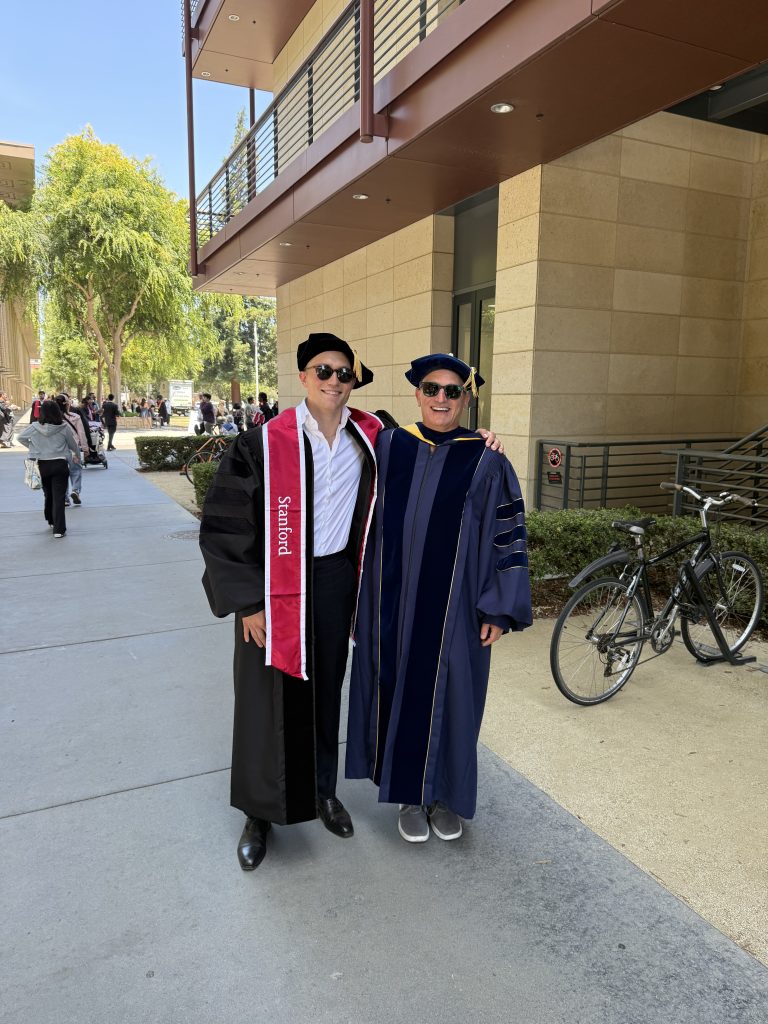
The Stanford environment supported not only research results, but also the professional habits needed to sustain them: careful experimental design, clear writing, and sharing code. During this period I also gave research presentations and produced materials meant to make the methods accessible to a broader audience (slides, expository writing, and open-source implementations). The stay culminated in my completed PhD thesis in the area of convex optimization applied to quantitative finance, and it helped prepare me for my current role as a quantitative researcher in New York.
Summary. During my stay at Stanford University, I pursued doctoral research in Professor Stephen Boyd’s group, focusing on convex optimization methods for quantitative finance. The environment at Stanford combined unusually strong research culture, easy access to interdisciplinary collaboration, and a steady flow of seminars that helped shape both the direction and the standards of my work. The period culminated in a completed PhD thesis and multiple research outputs (papers, talks, and open-source code) that aim to make modern optimization tools more usable in real financial settings. This report describes the academic environment and practical aspects of the stay, reflects on how my expectations were met, and gives a non-technical explanation of my research and its broader relevance.
Stanford University
Academic environment and research culture. Stanford’s research culture is both intense and unusually supportive. Within the School of Engineering (and especially the optimization and controls community), there is a strong expectation that ideas should be made precise, tested empirically when applicable, and communicated clearly. A major benefit of the environment is the density of high-quality seminars and informal discussions. It is easy to encounter experts passing through campus, to attend talks outside one’s immediate field, and to receive feedback early enough that it materially changes the outcome of a project.
My day-to-day work took place in an applied mathematics and optimization setting, but the content was motivated by problems in quantitative finance. That combination was particularly well supported at Stanford: people are comfortable moving between theory, algorithms, and practical implementation. I also found that the culture encourages sharing artifacts (code, experiments, and reproducible pipelines) as first-class research outputs, not as afterthoughts.
Interdisciplinary access. A second strength is the low friction for interdisciplinary collaboration. Even when projects are rooted in a core discipline (e.g., convex optimization), it is straightforward to connect with researchers in statistics, economics, and computer science. In practice, this means one can iterate quickly: ask questions, borrow tools, and validate assumptions with someone in another domain.
Social life and community. The social experience is what you make it, but Stanford offers many natural entry points: group meetings, reading groups, department social events, and a large international student and scholar community. For Swedish visitors, it is also easy to find informal networks of Scandinavians in the Bay Area. Practicalities: housing, transportation, and day-to-day logistics. Housing near campus is the single biggest practical challenge. Palo Alto and the surrounding area are expensive and
Practicalities: housing, transportation, and day-to-day logistics. Housing near campus is the single biggest practical challenge. Palo Alto and the surrounding area are expensive and competitive, and the earlier one starts, the better. In my case, the most workable options were (i) Stanford-affiliated housing when available, or (ii) shared housing within biking distance. For transportation, the campus and nearby neighborhoods are highly bicycle-friendly, and a bike is often the fastest way to get around locally. For longer trips, the Caltrain corridor provides mobility.
Administrative logistics (university onboarding, ID cards, access to buildings, software licenses, etc.) were generally smooth. The main recurring practical burdens were housing coordination and the general cost level, especially for rent and services.
Expectations: to what extent were they met?
My expectations going in. I expected Stanford to provide three things: (1) a high bar for research quality, (2) strong mentorship and peer feedback, and (3) enough intellectual breadth that I could test ideas across fields (optimization, statistics, and finance) without constantly “starting from zero.” I also hoped for an environment that values clear writing and reproducible implementation.
How the experience compared to expectations. These expectations were met, and in several respects exceeded. The quality of feedback, both from my immediate group and from the broader seminar ecosystem, had direct impact on the final form of my work. The availability of nearby expertise made it easier to identify weak points early (e.g., unrealistic modeling assumptions, insufficient evaluation design, or missing baselines) and to correct them before they became entrenched. The culture of rigorous communication also improved my writing: there is a strong norm that papers and presentations should be understandable to a technically trained audience outside the narrow subfield.
Would I recommend Stanford to others in my area? YES!!! For Swedish students and researchers working in optimization, machine learning, applied math, or quantitative finance, Stanford can be an outstanding place to study or conduct research. The caveat is practical: the cost of living (especially housing) is high, and the pace can be demanding. However, if one has a well-scoped research plan and uses the seminar and collaboration opportunities actively, the academic return can be exceptional.
My research in accessible terms (for non-specialists)
The high-level problem. Many important decisions, in finance, engineering, and public policy, can be phrased as: choose the best action subject to constraints. Examples include allocating a budget, designing a system under safety limits, or building an investment portfolio under risk limits. In real life, these decisions have many moving parts: uncertainty, noisy data, and constraints that come from regulation, transaction costs, or operational limitations. The central question is how to make such decisions systematically, rather than by rules of thumb.
What convex optimization is (without the math). Convex optimization is a class of methods for making decisions when the problem has a certain “well-behaved” structure. When that structure holds, we can compute globally optimal solutions reliably and quickly, even for fairly large problems. A helpful mental model is: instead of searching blindly for a good solution, convex optimization gives you a landscape where any local improvement leads you toward the best possible outcome.
Why this matters in quantitative finance. In quantitative finance, one repeatedly solves decision problems such as:
- How should we allocate capital across many assets to balance expected return and risk?
- How do we account for transaction costs, liquidity limits, and turnover constraints?
- How do we estimate and manage risk when markets change over time?
- Can we build systematic trading strategies that are robust rather than overfit?
These are decision problems with constraints, exactly the setting where optimization is a natural tool. But financial data is noisy and markets change. So the core challenge is not only solving an optimization problem, but also deciding what inputs to feed it (e.g., risk estimates) and how to evaluate whether a method is reliable.
Main themes of my work during the stay. My research focused on using convex optimization to make quantitative finance methods:
1. More principled: replacing ad-hoc tuning with transparent objectives and constraints.
2. More robust: designing methods that perform across different market regimes rather than only in a particular historical window.
3. More reproducible: building implementations that others can run and audit.
A recurring example is portfolio construction. The classical approach (often associated with Harry Markowitz) balances expected return against risk. In practice, this becomes more complex because one must estimate risk from historical data, and because constraints (like limits on leverage, sector exposure, or trading volume) matter a lot. Convex optimization lets us express these constraints explicitly and solve the resulting problem efficiently.
Another theme is risk estimation, such as predicting covariance matrices (a summary of how asset returns move together). If the risk estimate is poor, even a perfectly solved optimization problem can produce a fragile portfolio. Part of my work examined simple, effective ways to generate risk estimates that adapt over time, and how to evaluate them under changing market conditions.
I worked on systematic trading strategies that can be formulated as optimization problems, for example, identifying and managing collections of statistical arbitrage opportunities under realistic constraints. The key idea is to translate a trading intuition into a decision problem that can be stress-tested and solved consistently.
Outputs and professional development. The Stanford environment supported not only research results, but also the professional habits needed to sustain them: careful experimental design, clear writing, and sharing code. During this period I also gave research presentations and produced materials meant to make the methods accessible to a broader audience (slides, expository writing, and open-source implementations). The stay culminated in my completed PhD thesis in the area of convex optimization applied to quantitative finance, and it helped prepare me for my current role as a quantitative researcher in New York.
Reflections, lessons learned, and advice to future stipendiates
1) Be intentional about feedback loops. The biggest advantage of a place like Stanford is not only the raw talent around you, but the speed of feedback. Go to seminars outside your narrow topic, ask “naive” questions early, and share drafts sooner than feels comfortable. The goal is to discover misunderstandings while they are cheap to fix.
2) Treat implementation as part of the research. In quantitative fields, the line between theory and practice is thin. Many ideas fail not because the math is wrong, but because they do not survive contact with messy data and operational constraints. Building reproducible pipelines and writing clean code is not just engineering, it is a research strategy that forces clarity.
3) Budget time for life logistics. Housing and cost of living can quietly dominate attention. Start early, and do not underestimate how much mental space a difficult housing situation consumes. If possible, choose a living arrangement that reduces commute friction and supports a sustainable routine.
4) Build community deliberately. It is easy to drift into isolation when work is demanding. Choose a few recurring social anchors (weekly seminar, reading group, sports, or a standing coffee) and treat them as part of the professional plan, not as optional extras.
5) Recommendation in one sentence. If you can manage the practicalities, Stanford offers an unusually high-return environment for Swedish researchers who want rigorous methods, broad interdisciplinary exposure, and strong standards for research communication.